Morse Code Alphabet A to Z: Letters, Numbers and Chart
The Morse code alphabet A to Z gives each of the 26 letters its own pattern of dots and dashes, and the same system covers the digits 0 to 9 and common punctuation. The chart below shows 54 characters in international Morse, including five common extensions beyond ITU-R M.1677-1, with a play button on every tile so you can hear the rhythm as well as see it. Press Play A to Z to hear the whole alphabet at 14 words per minute, which takes about 25 seconds, or filter the chart down to letters, numbers or punctuation.
Play A to Z14 WPM
.- -... -.-. -.. . ..-. --. .... .. .--- -.- .-.. -- -. --- .--. --.- .-. ... - ..- ...- .-- -..- -.-- --..
Ready when you are.
Flashing light may affect sensitive viewers. Tap the screen or press Esc to stop.
How to read the Morse code chart
A Morse code chart is read in time, not in ink: a dot lasts one unit, a dash lasts three, and the silences between them are part of the code. The unit itself has no fixed length. It is set by the sending speed, so at 20 words per minute a dot is 60 milliseconds and at 14 WPM it stretches to about 86 milliseconds.
| Element | Length | Example |
|---|---|---|
| Dot (dit) | 1 unit | the single signal in E |
| Dash (dah) | 3 units | the single signal in T |
| Gap inside a letter | 1 unit | the pause between the dot and dash of A |
| Gap between letters | 3 units | S to O in SOS |
| Gap between words | 7 units | shown as a slash (/) in written Morse |
The gaps are what separate letters from strings of letters. Dot, short pause, dash is A; dot, long pause, dash is the two letters E and T. When you write Morse by hand, put one space between letters and a slash between words so the reader can keep those gaps straight.
Morse code letters A to Z by length
Every Morse code letter uses between one and four signals, and sorting the alphabet by that count is the quickest way to see its shape. Two letters need a single signal, four need two, eight need three and the remaining twelve need four.
| Signals | Letters | Codes |
|---|---|---|
| 1 | E, T | . / - |
| 2 | A, I, M, N | .- / .. / -- / -. |
| 3 | D, G, K, O, R, S, U, W | -.. / --. / -.- / --- / .-. / ... / ..- / .-- |
| 4 | B, C, F, H, J, L, P, Q, V, X, Y, Z | -... / -.-. / ..-. / .... / .--- / .-.. / .--. / --.- / ...- / -..- / -.-- / --.. |
Several pairs are reversed or inverted versions of each other, which is where most mix-ups happen: A (.-) and N (-.), D (-..) and U (..-), G (--.) and W (.--) are reversed; K (-.-) and R (.-.) swap dots for dashes. Each letter above links to its own page, where you can hear it, flash it and compare it with the patterns it is confused with.
Morse code numbers 0 to 9
Morse code numbers are more regular than the letters: every digit is exactly five signals long, and the dots and dashes move in a fixed order. One is a dot followed by four dashes; each digit up to five swaps one dash for a dot; six starts the cycle again with a dash.
| Digit | Code | Pattern |
|---|---|---|
| 1 | .---- | 1 dot, 4 dashes |
| 2 | ..--- | 2 dots, 3 dashes |
| 3 | ...-- | 3 dots, 2 dashes |
| 4 | ....- | 4 dots, 1 dash |
| 5 | ..... | 5 dots |
| 6 | -.... | 1 dash, 4 dots |
| 7 | --... | 2 dashes, 3 dots |
| 8 | ---.. | 3 dashes, 2 dots |
| 9 | ----. | 4 dashes, 1 dot |
| 0 | ----- | 5 dashes |
Radio operators sometimes shorten these to cut numbers, collapsing a run of dashes into one, so 9 becomes N (-.) and a signal report of 599 is sent as 5NN. Cut numbers are not part of the ITU table and only work when both sides expect a number, so learn the full forms from this Morse code numbers chart first.
Punctuation and procedure signs
The international table also defines punctuation, and the six below cover almost everything that appears in ordinary messages. Use the Punctuation filter above to play all 18 patterns the chart supports.
| Sign | Code | Notes |
|---|---|---|
| Period (full stop) | .-.-.- | also marks the end of a sentence in written Morse |
| Comma | --..-- | |
| Question mark | ..--.. | |
| Apostrophe | .----. | |
| Slash (fraction bar) | -..-. | also used as a word separator |
| At sign | .--.-. | added to the ITU table in 2004 |
Thirteen of the 18 patterns come from ITU-R M.1677-1. The exclamation mark, ampersand, semicolon, underscore and dollar sign are common extensions used by amateur operators and by most translators, including this one. The same standard defines procedure signals such as the error sign (eight dots), understood (...-.) and end of work (...-.-); those are explained on the signal-meaning page.
Printable Morse code alphabet chart (PDF and PNG)
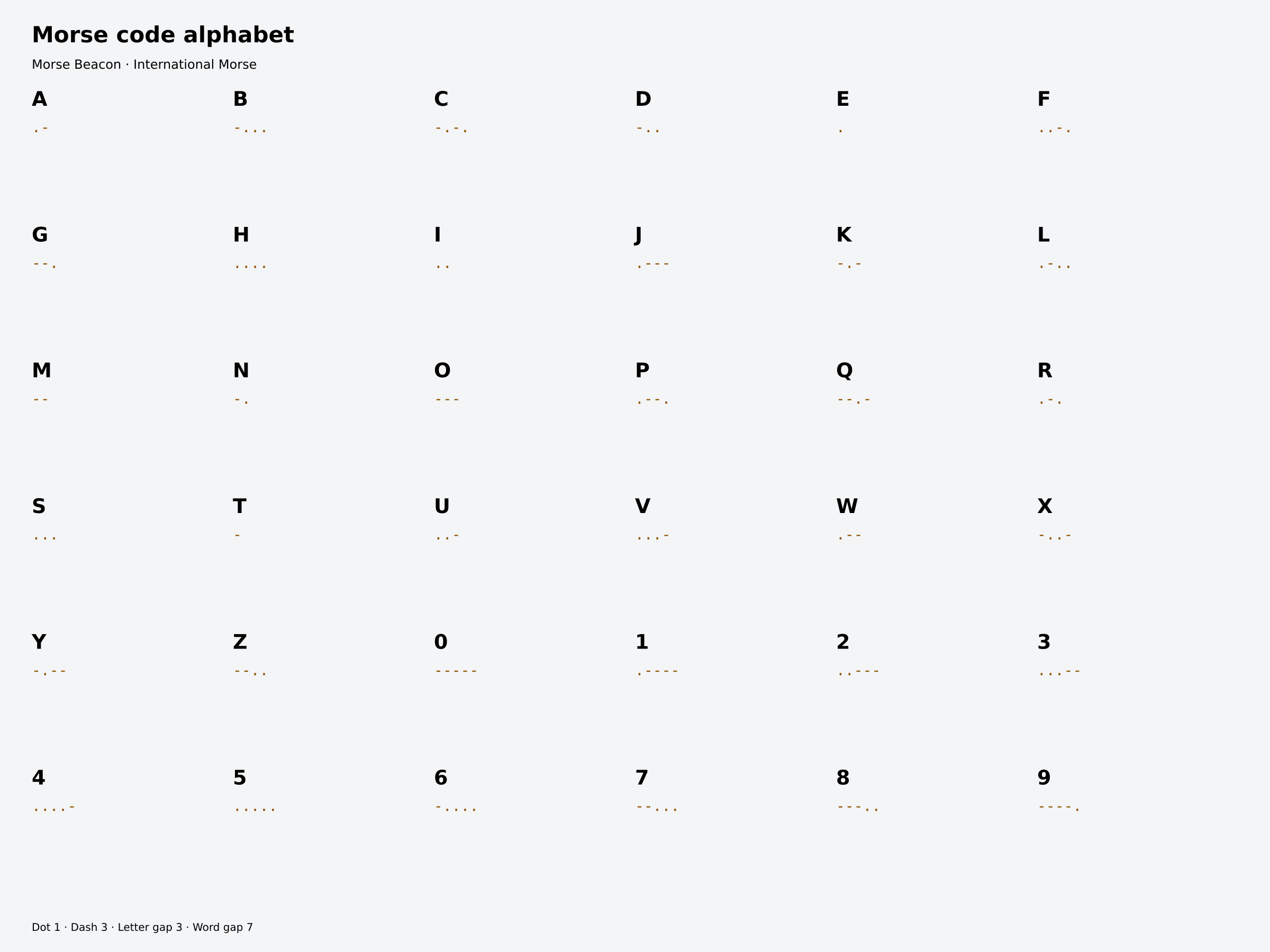
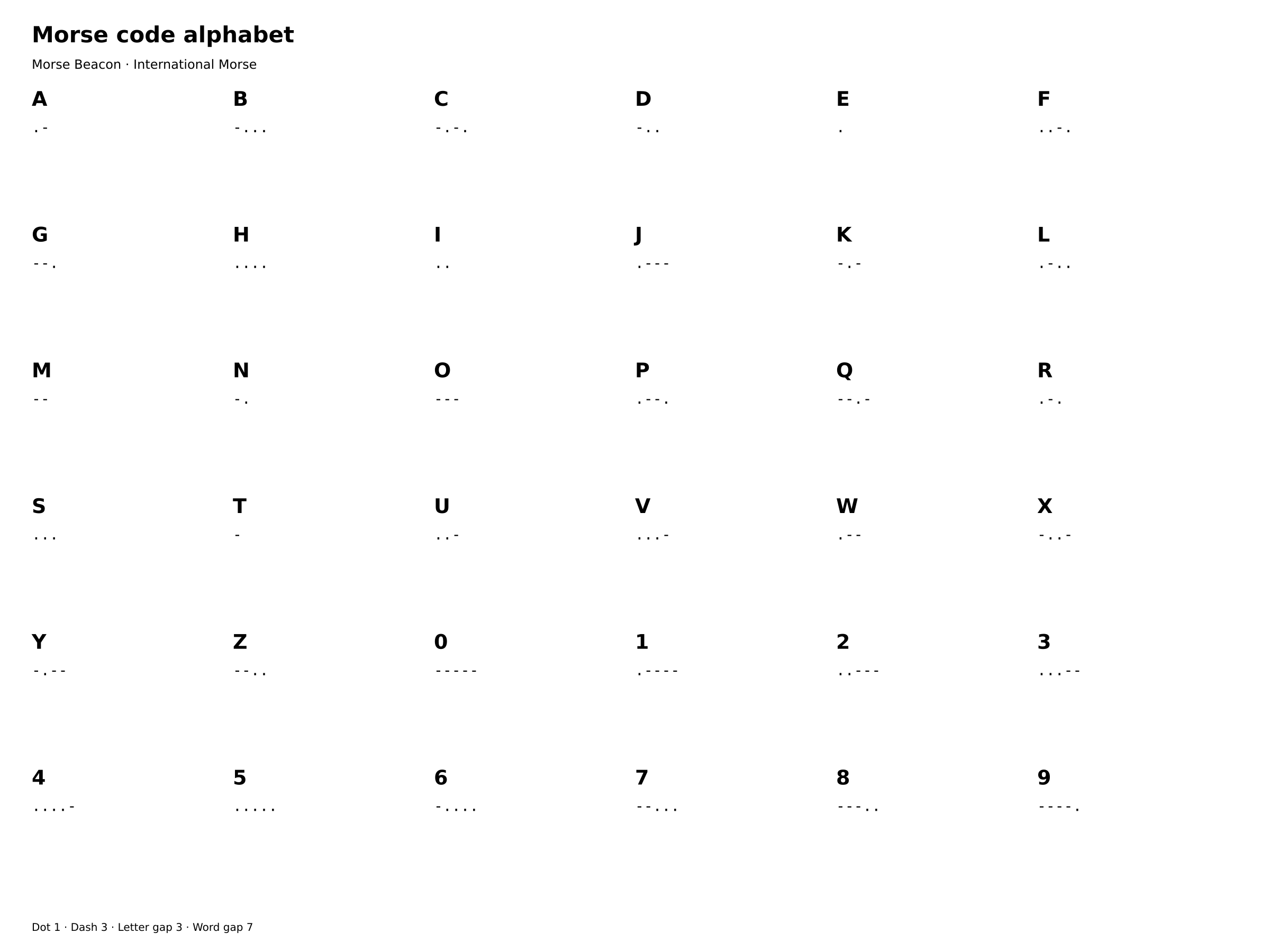
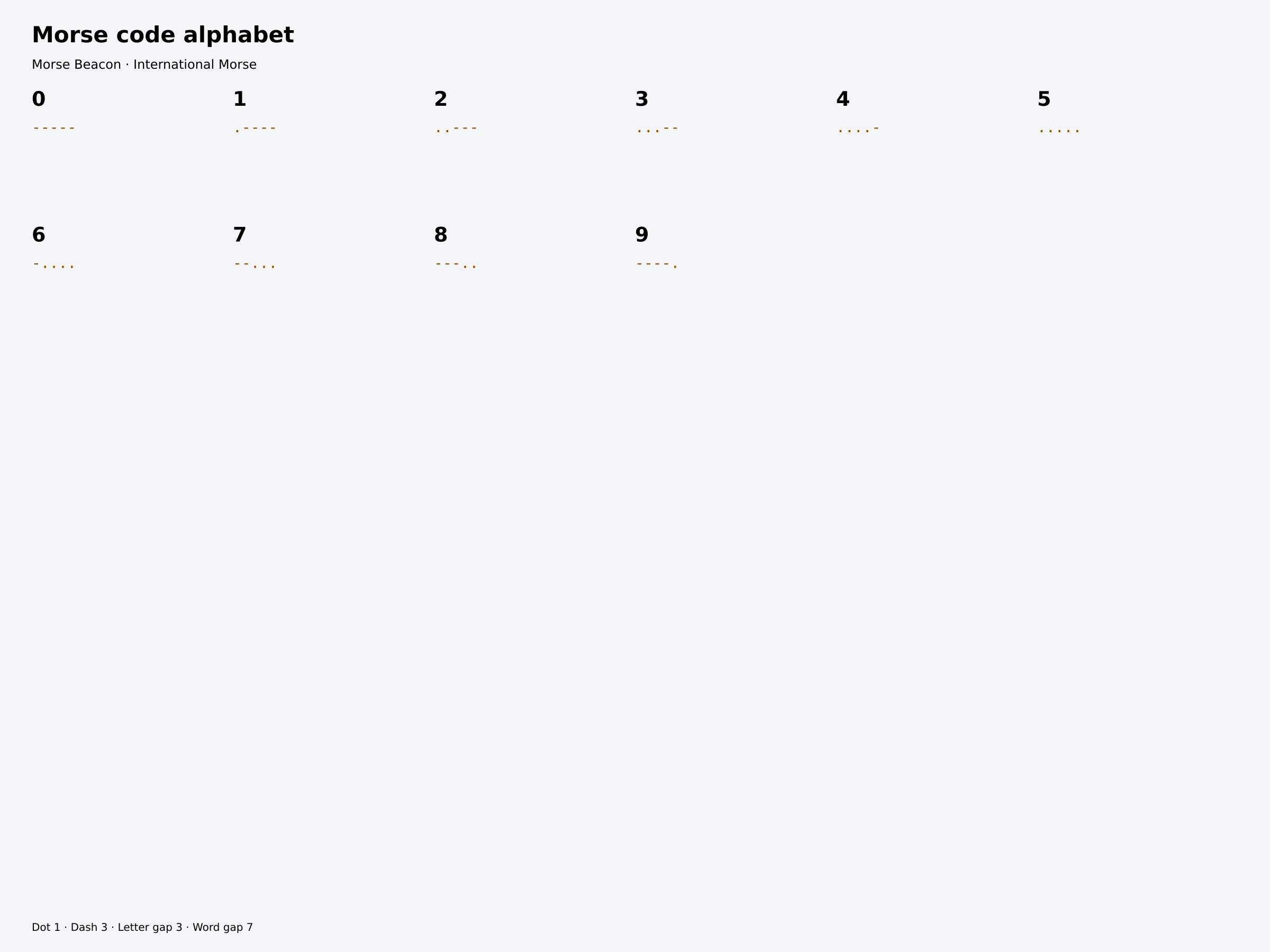
A printable Morse code alphabet chart is in the download grid below, in eight versions, so you can pick the one that fits where it will live. The Morse code alphabet chart PDF comes in Letter and A4 layouts, each listing all 54 characters with their codes on one page. The PNG charts are 2,400 pixels wide, in color or black and white, for classroom walls and screens, and the numbers-only chart isolates the 10 digits.
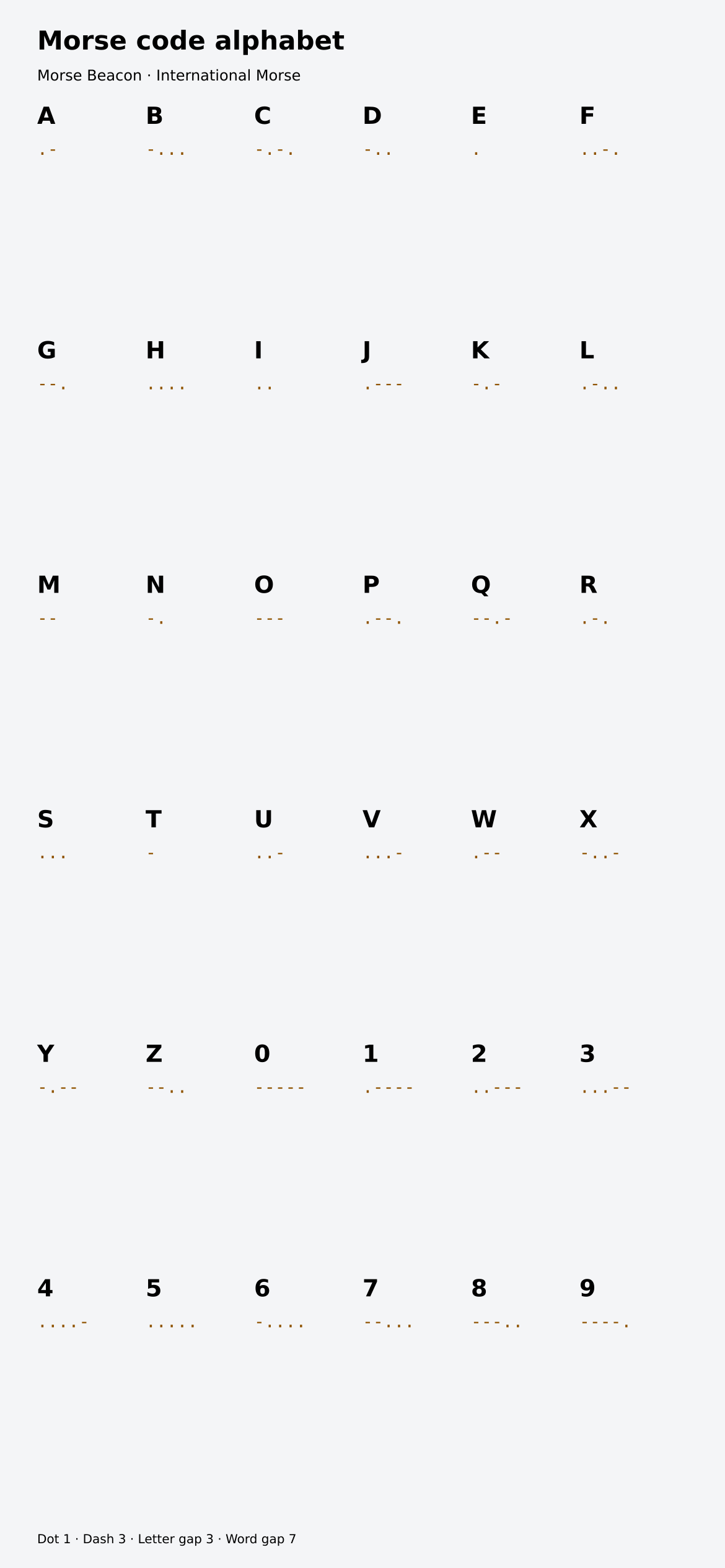
Three smaller formats exist for carrying the alphabet with you: a phone wallpaper sized for a lock screen, a wallet card and a kids practice sheet with blank lines beside each letter. The full-size charts and the practice sheet carry the timing rule along the footer, dot 1, dash 3, letter gap 3, word gap 7, so the chart and the rhythm stay together. If you want a single word rather than the whole alphabet, the picture translator turns any phrase into a Morse code image you can save.
Morse code decoding tree
A Morse code decoding tree reads a pattern one signal at a time instead of looking it up as a whole, which is how the pattern is actually received. The interactive tree below walks the same branches.
- Start at the top of the tree. The first signal splits the alphabet in two: a dot takes you to E, a dash to T.
- Add the second signal. From E, a dot reaches I and a dash reaches A; from T, a dot reaches N and a dash reaches M.
- Keep going, one branch per signal. Four levels of the tree hold all 26 letters; the digits sit on a fifth level.
- Stop when the letter gap arrives. The branch you are standing on is the character, which is why the gaps matter as much as the signals.
- Press Reset and try another pattern, or open the letter page from the result.
The tree also explains why code order differs from alphabetical order on an operator's reference sheet: letters are listed level by level as the tree reaches them: E, T, then I, A, N, M, then S, U, R, W, D, K, G, O, and so on.
Interactive decoding tree
Walk from the start: dot or dash. Reset to try another letter.
Choose your first signal.
Why E is one dot: how the alphabet was built
E is one dot because the people who designed the alphabet matched each code's length to how often the letter appears in English. Alfred Vail, working with Samuel Morse in the late 1830s, estimated letter frequency by counting the movable type in a Morristown, New Jersey newspaper office, then gave the commonest letters the shortest patterns. E and T, the two most frequent letters, got a single signal each.
That original code, now called American Morse, went into service on the telegraph in 1844. Friedrich Gerke simplified it in 1848 so that it used only dots and dashes, and the International Telegraph Convention in Paris adopted a revised version on 17 May 1865, keeping most of Gerke's letters and redesigning all the digits. The International Telecommunication Union still maintains that alphabet as Recommendation ITU-R M.1677-1, which is the table every tool on this site is generated from.
International vs American Morse alphabet
The chart above is the international alphabet, used for radio and modern reference charts; American Morse was chiefly used on North American landline telegraphs. The two systems share many letters, but 11 letters and 9 of the 10 digits differ, and American Morse uses internal spaces and extra-long dashes that the international code dropped.
| Character | International | American Morse |
|---|---|---|
| C | -.-. | .. . (dot, dot, space, dot) |
| F | ..-. | .-. |
| L | .-.. | one long dash |
| O | --- | . . (dot, space, dot) |
| R | .-. | . .. (dot, space, dot, dot) |
| 0 | ----- | one very long dash |
If you see a chart where C is two dots, a space and a dot, you are looking at the older landline code. The telegraph page on this site lets you key messages in either system and hear the difference on a virtual sounder.
How to learn the alphabet from this chart
Learning the Morse code alphabet goes faster by ear than by eye, and this page is built around that: every character here plays as sound and light.
- Press Play A to Z once and listen without reading. The aim is to hear the rhythm of the alphabet, not to decode it yet.
- Filter to Letters and play the one-signal and two-signal letters (E, T, A, I, M, N) until you recognize each by sound alone.
- Open a letter's page for its memory cue and its look-alike pairs, then come back and play the pair side by side on the chart.
- Walk the decoding tree with your eyes closed while a friend taps a letter on the table; say the letter when the taps stop.
- Move to the practice trainer, which sends characters at 18 WPM with long gaps and keeps a list of the letters you miss.
Ten minutes a day is enough for the alphabet. The learning plan on this site schedules the rest: the Koch order, Farnsworth timing, the timed test and the tapper.
Common things to translate
Questions people ask
How many characters are in the Morse code alphabet?
The international Morse code alphabet has 26 letters and 10 digits. This chart also includes 18 punctuation and symbol patterns, 54 characters in all, which you can filter with the buttons above the tiles.
Is the Morse code alphabet the same in every language?
The 26 letters A to Z are the same wherever international Morse is used. Languages with extra letters add patterns of their own: ITU-R M.1677-1 defines an accented E (..-..), and German, Russian and Japanese each use additional tables, with Japanese kana sent as Wabun code.
Which Morse code letters are the longest?
Twelve letters use four signals: B, C, F, H, J, L, P, Q, V, X, Y and Z. No A–Z letter needs five signals; every digit does, and some punctuation marks use five or more.
What is the difference between a dot and a dash?
A dot is one unit of time and a dash is three; both are the same tone or light, only the length changes. Written Morse shows them as . and -, and operators say them as dit and dah.
How long should the gaps be when I write or tap Morse code?
Leave one unit between signals inside a character, three units between letters and seven between words. On paper, one space stands for the letter gap and a slash for the word gap, so SOS written as a word is ... --- ... and as a distress call it is sent as one run, ...---..., with no letter gaps between S, O and S (the 1-unit gaps between signals stay).
Can I print this Morse code chart?
Yes. The download grid above has Letter and A4 PDFs, color and black-and-white PNGs, a numbers-only chart, a phone wallpaper, a wallet card and a kids practice sheet, all generated from the same ITU table as the tiles.
Checked against ITU-R M.1677-1 · Last reviewed · How we check our pages · Report it